Why are 4 piston calipers better than 2?

Collapse
X
 
  • Filter
  • Time
  • Show
Clear All
new posts
  • Steve
    eMechanic
    TCS Auto-X Driver
    • Nov 2002
    • 5381

    #16
    Originally posted by sport the war View Post
    i've heard of rotor's shattering because of floating design's cause the rotor to shimmy at speed and with the heat i heard it shatters, i was going off what i've heard as to why going to a 2-4 piston calipers, that's why they give you a larger contact area to prevent shudder.

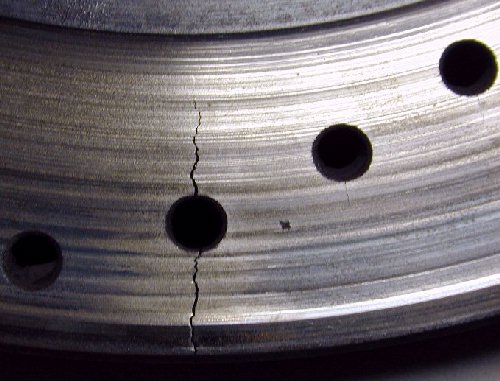
    testing of a supercar breaking system, not fully at speed either. you tell me nooblets, is that hot enough to break a rotor? geee...


    So............. let me get this straight. Your entire brake system logic is loosely based and some lame assed rendering of a brake dyno that was enhanced because some slang speaking jizz monkey might think it will look cool and buy some "Nissin" calipers? Why else would we be staring at the brand name? I don't put my company logo on a single one of my test units at work. Seems like a waste of money. Ever seen calipers get that hot and not change color and burn paint? Not me......

    There are MANY other things that contribute to a rotor cracking. First is basic automotive maintenance. Hubs and Rotors must be checked frequently for cracks and excessive play, especially on track cars. Another contributor is proper cooling (IE driving through puddles with hot rotors).

    My *opinion* on Scot's question is.............Yes, you do get better load distribution on the pads, but you also get RADIAL MOUNT MONOBLOCK calipers that are MUCH!!!!! more rigid than those silly Cobra calipers we use. Did you know that without that minor amount of ribbing on those cobra calipers they would spread and render themselves useless after a hard weekend of use on the track? Don't believe me? Go ask ANY CMC/AS camaro guy.

    Sorry to be an ass, but you asked for it. By entering Scot's thread that was based on fluid dynamics (you know, actual fact!) and interjecting your wisdom
    Last edited by Steve; 09-09-2006, 07:52 AM.
    My couch pulls out but I don't.

    Comment

    • HTMtrSprt
      TCS Regular
      • May 2003
      • 488

      #17
      First, the 4 or 6 piston calipers are much more rigid than the PBR calipers that flex pretty badly when they get hot, causing uneven loading of the pads ( and uneven wear) resulting in sub-standard braking. Secondly, the non-sliding caliper design opens the top of the caliper allowing quick and easy pad changes without removing the caliper body (very important in endurance racing where pad changes may be needed during the race).

      Brian
      HiTech Motorsport

      Comment

      • bad-speller
        TCS Homer
        • Feb 2004
        • 943

        #18
        I have been thinking about this today and want to make sure I am making my prior post clear........and am interpeting Scotts question correctly? (I apologize to Volecity for my harsh post last night. I think I understand what you were saying and the way you interpeted scotts question, you were right.)

        Clamping force of a caliper is a function of the total surface area of all the pistons added together. In other words, if a two piston caliper has two 1" diameter pistons and a four piston setup has .5" pistons, all else equal the clamping force between the two would be equal.

        Brian
        2006 NASA American Iron Midwest Champion
        2005 NASA American Iron Midwest Champion.
        2010 Camaro SS (My New Racecar, coming soon)
        08 Corvette Z06
        09 BMW M3: Interlagos blue, SMG II
        00 Mustang Cobra R
        95 Mustang Cobra R (#23 NASA AI midwest)
        94 Mustang Cobra (#23 NASA AI midwest) SOLD
        09 BMW X3

        My braking point entering a corner is when I see the corner worker raising the yellow flag for me

        Comment

        • bad-speller
          TCS Homer
          • Feb 2004
          • 943

          #19
          Originally posted by ScotWithOne_t View Post
          If the idea is to get an evenly distrubuted load on the pad, then wouldn't a cast peice of aluminum provide a more rigid and even surface pressing against the pad than 2 or 3 pistons that can move independently?
          Not sure if I understand your question totally, but you bring up another good point. (I think)

          The better brake systems will not have all the pistons the same size for exactly the reason you mention. To keep the load as well distributed as possible they may run smaller pistons in the front of the caliper as opposed the the rear to keep the pad wear even (or as even as possible)

          You mention the 2000 Cobra R Brembo setup, they run equal size pistons. I consider that system a marginal upgrade at best. (and yes, it is what I have on my race car and my cobra R's.)

          Brian
          2006 NASA American Iron Midwest Champion
          2005 NASA American Iron Midwest Champion.
          2010 Camaro SS (My New Racecar, coming soon)
          08 Corvette Z06
          09 BMW M3: Interlagos blue, SMG II
          00 Mustang Cobra R
          95 Mustang Cobra R (#23 NASA AI midwest)
          94 Mustang Cobra (#23 NASA AI midwest) SOLD
          09 BMW X3

          My braking point entering a corner is when I see the corner worker raising the yellow flag for me

          Comment

          • VELOCITY
            Pacer's RULE!!!
            • Feb 2003
            • 2900

            #20
            Originally posted by bad-speller View Post
            I have been thinking about this today and want to make sure I am making my prior post clear........and am interpeting Scotts question correctly? (I apologize to Volecity for my harsh post last night. I think I understand what you were saying and the way you interpeted scotts question, you were right.)

            Clamping force of a caliper is a function of the total surface area of all the pistons added together. In other words, if a two piston caliper has two 1" diameter pistons and a four piston setup has .5" pistons, all else equal the clamping force between the two would be equal.

            Brian

            No big deal, I was assuming that the piston diameters were the same between the two and four piston calipers. But for my example to really work you would need a new master cylinder that moves a larger volume of fluid.

            Comment

            • sport the war
              لا أحد يعلم ما يقول هذا لكنها
              • Dec 2004
              • 17482

              #21
              my point was, why upgrade to a brake system designed for a supercar when you're never going to reach the speeds that the unit was designed for? but then again.. it's your money. brake fluid temps shouldnt be a problem with rims that are venting the gases. if your not... or if you're feeling like you're going to break a line, go buy some braided steel reinforced lines.

              Originally posted by CAMSS30
              I have my hand on the pulse of CL users after 7-8 years of dealing with them daily.

              Comment

              • StangerJon
                esse jay
                TCS Auto-X Driver
                • Oct 2003
                • 16655

                #22
                Originally posted by sport the war View Post
                my point was, why upgrade to a brake system designed for a supercar when you're never going to reach the speeds that the unit was designed for? but then again.. it's your money. brake fluid temps shouldnt be a problem with rims that are venting the gases. if your not... or if you're feeling like you're going to break a line, go buy some braided steel reinforced lines.
                well shit, with that logic why upgrade brakes at all?

                Comment

                • Steve
                  eMechanic
                  TCS Auto-X Driver
                  • Nov 2002
                  • 5381

                  #23
                  Originally posted by sport the war View Post
                  my point was, why upgrade to a brake system designed for a supercar when you're never going to reach the speeds that the unit was designed for? but then again.. it's your money. brake fluid temps shouldnt be a problem with rims that are venting the gases. if your not... or if you're feeling like you're going to break a line, go buy some braided steel reinforced lines.
                  Do you understand that you don't need to run 200 mph to benefit from nice brakes? Have you ever ridden/driven in a car with a racing compund tires on all four corners?
                  My couch pulls out but I don't.

                  Comment

                  • KickAssFlash
                    TCS AutoX Driver
                    TCS Auto-X Driver
                    • Jul 2004
                    • 11568

                    #24
                    Originally posted by 92MNstanger View Post
                    Have you ever ridden/driven in a car with a racing compund tires on all four corners?

                    Comment

                    • bad-speller
                      TCS Homer
                      • Feb 2004
                      • 943

                      #25
                      Originally posted by sport the war View Post
                      my point was, why upgrade to a brake system designed for a supercar when you're never going to reach the speeds that the unit was designed for? but then again.. it's your money. brake fluid temps shouldnt be a problem with rims that are venting the gases. if your not... or if you're feeling like you're going to break a line, go buy some braided steel reinforced lines.

                      1, Show me a brake company that makes specific statements on what speeds their brake system was designed for (let alone 200+ mph)

                      2, what does "brake fluid temps shouldnt be a problem with rims that are venting the gases" mean? You totally lost me on this one.

                      3, A car slowing from 150 mph to 50 mph will produce a given amount of heat. This heat is the same whether you have 6 piston calipers or 2 piston calipers.

                      4, Braided lines are a very good investment, in fact we won't even allow 98 and older mustangs on the track without upgraded brake lines. It's a safety issue, not a performance upgrade.

                      Brian
                      2006 NASA American Iron Midwest Champion
                      2005 NASA American Iron Midwest Champion.
                      2010 Camaro SS (My New Racecar, coming soon)
                      08 Corvette Z06
                      09 BMW M3: Interlagos blue, SMG II
                      00 Mustang Cobra R
                      95 Mustang Cobra R (#23 NASA AI midwest)
                      94 Mustang Cobra (#23 NASA AI midwest) SOLD
                      09 BMW X3

                      My braking point entering a corner is when I see the corner worker raising the yellow flag for me

                      Comment

                      • ScotWithOne_t
                        OMGfast. Always.
                        • Jan 2005
                        • 5849

                        #26
                        Originally posted by bad-speller View Post
                        Clamping force of a caliper is a function of the total surface area of all the pistons added together. In other words, if a two piston caliper has two 1" diameter pistons and a four piston setup has .5" pistons, all else equal the clamping force between the two would be equal.
                        This is exacly the myth I am trying to dispell. In the scenario you just described, the two piston caliper with two 1" dia pistons will have more clamping force that a 4 piston with 4x .5" dia pistons. Reason being, in the 4 piston caliper, you only have 2 pistons on each side. Now, a 4 piston caliper with 2X 1" pots on each side, would have the same hydraulic force as a two piston caliper with 2X 1" pots on the one side. In the 2 pitson caliper, the casting of the caliper is providing the force that is opposing the pistons on the other side of the rotor....in a 4 pot caliper, you simply have two equal sets of pistons apposing each other, but the total clamping force can not be greater than what one sidecan produce.

                        Think of it this way. If you have a tug of war game, with two guys on each end of the rope, each pulling 100lbs of force, the tension in the rope is only 200lbs, not 400lbs. This would be the same as two guys each pulling 100lbs of force on one end of a rope that is tied to a wall on the other end.

                        I don't mean to insult anyone's intelligence by over explaining this, but until I actually put some thought into it, thought about the direction at which the forces are being applied, and drew a free-body diagram in my head,
                        I was under the impression that more pistons (or more specifically, piston area) = more clamping force.

                        I think my original question of "why use 4 pistons when 2 can clamp just as hard?" has been anwered though. From what I gather, you get more even pad wear, the calipers are more durable and rigid, and the pads can be changed out quicker and easier? Is there anything I missed?
                        http://scotspage.blogspot.com/

                        Comment

                        • ScotWithOne_t
                          OMGfast. Always.
                          • Jan 2005
                          • 5849

                          #27
                          Originally posted by sport the war View Post
                          my point was, why upgrade to a brake system designed for a supercar when you're never going to reach the speeds that the unit was designed for? but then again.. it's your money. brake fluid temps shouldnt be a problem with rims that are venting the gases. if your not... or if you're feeling like you're going to break a line, go buy some braided steel reinforced lines.
                          Seriously...if you have no idea what you're talking about, why even try to engage in a technical discussion?
                          http://scotspage.blogspot.com/

                          Comment

                          • 68GTO
                            The Coach Z
                            • Sep 2003
                            • 15772

                            #28
                            Guys,

                            Being a guy who has driven a car with 60's era steel 4-piston caliper brakes (68 GTO factory 4-piston option), I had to learn long ago about pistons, clamping force, rotor diameter, line flex, etc. It's all important. The real question here is on the pistons and the design. Here are some facts and some thoughts...

                            The floating design was designed by the car manufacturers essentially to make the caliper less expensive to produce. It successfully applies the physics principle of "for every action caused an opposite and equal reaction happens.

                            The big advantages to the full floating design (single piston):
                            1. if the rotor has a slight run out (wobble), the floating feature will compensate
                              without creating any instability
                            2. the single piston design is easier to bleed

                            The disadvantages:
                            1. heavier
                            2. retains heat
                            3. requires approximately 100 pounds of pressure more to "slide" the caliper and requires more volume of brake fluid due to the diameter of the piston

                            Most race applications use this type of caliper, because they are generally are made of aluminum which displaces the heat faster and requires both less pressure and less volume to operate. Does the volume effect the braking? Yes, it has a great effect on the master cylinder volume that is required for all 4 wheels. This will mean you will have to use a larger diameter master cylinder to meet the requirements of the calipers. The larger the master cylinder is the lower the pressure output. (Boyle's Law states that under conditions of constant temperature and quantity, there is an inverse relationship between the volume and pressure)

                            Calipers made of aluminum are also not subject to corrosion and rust, like the Corvette calipers in the 60’s. The fixed design allows the entire piston to be applied at the same pressure, because the pressure is equalized when pressure is applied, thereby allowing the rotor to be squeezed by opposing forces (piston on each side). Aluminum will displace heat 1.5 to 3 times faster than the cast iron or steel calipers.

                            The six (6) piston caliper is about the greatest thing since disc brakes itself. Generally there are four (4) smaller pistons and two (2) larger pistons. The two different size pistons allow the caliper to work at different levels without having as all the pistons operating at the same time. When you only need a little braking the 4 smaller pistons do the work, when you need to really stop the bigger pistons are activated. This is a great solution for street cars.


                            All else being equal, more pistons is still a better solution.
                            Captain Obvious reporting for duty.
                            • Bullet point mafia
                            There = a place
                            Their = belonging to someone, possessive
                            They're = contraction of they + are

                            Comment

                            • ScotWithOne_t
                              OMGfast. Always.
                              • Jan 2005
                              • 5849

                              #29
                              I'm not sure why you mentioned Boyle's law. It applies only to ideal gasses. P1V1 = P2V2. This has nothing to do with brake fluid and fluid mechanics. I DO understand the point you were making about a larger master cylinder moving more more fluid, but losing some hydraulic mechanical advantage....however this has nothing to do with Boyle's law.

                              Originally posted by 68GTO View Post
                              The six (6) piston caliper is about the greatest thing since disc brakes itself. Generally there are four (4) smaller pistons and two (2) larger pistons. The two different size pistons allow the caliper to work at different levels without having as all the pistons operating at the same time. When you only need a little braking the 4 smaller pistons do the work, when you need to really stop the bigger pistons are activated. This is a great solution for street cars.
                              I've never heard of that before. Is there some sort fo valve inside the caliper that is activated under greater fluid pressure or something?
                              http://scotspage.blogspot.com/

                              Comment

                              • OrangeCrush 86
                                /yawn
                                • Nov 2005
                                • 10085

                                #30
                                Originally posted by ScotWithOne_t View Post
                                I'm not sure why you mentioned Boyle's law. It applies only to ideal gasses. P1V1 = P2V2. This has nothing to do with brake fluid and fluid mechanics. I DO understand the point you were making about a larger master cylinder moving more more fluid, but losing some hydraulic mechanical advantage....however this has nothing to do with Boyle's law.


                                I've never heard of that before. Is there some sort fo valve inside the caliper that is activated under greater fluid pressure or something?
                                I think it would be because of the ratio. 4 smaller pistons would travel a longer distance than the larger piston since the MC moves a fixed amount of fluid, thus they would apply force to the rotor first. On the other hand, I have never heard of this design before so I couldn't really tell you. I just know the laws of hydrodynamics.

                                Comment

                                Working...
                                X
                                😀
                                😂
                                🥰
                                😘
                                🤢
                                😎
                                😞
                                😡
                                👍
                                👎